
Chaska Records by Purpose
A name check works best when the record matches the question. Carver County Property Information ties a record owner to a Chaska parcel, while LandShark preserves Chaska recorded transactions. Minnesota Court Records Online, called MCRO, is the route for public Chaska district-court activity. The Minnesota Department of Health, county vital office, MOMS marriage system, and historical indexes serve different Chaska family-event questions. None of these sources creates one complete list of Chaska residents.
| Record | What it can confirm | Chaska route | Access |
|---|---|---|---|
| Property assessment | Record owner, Chaska parcel, situs and mailing address | Carver Property Information | Public current app |
| Recorded land record | Buyer, seller, Chaska legal description and recording date | LandShark | Online from 1988; older records at the recorder |
| Court case | Party role, Chaska case number, activity and disposition | MCRO | Public material only |
| Vital index or certificate | Chaska birth, death, marriage, and relationship leads | Minnesota Department of Health | Index and certificate rules differ |
| Historical collection | Chaska listed subscriber, obituary, yearbook, or family clue | Chaska History Center and county historical collections | Often onsite |
Start from the least sensitive stable Chaska fact. A Chaska parcel, Chaska case number, published Chaska obituary date, or documented Chaska school year is more useful than a name alone. Keep the source date beside every result. A current Chaska tax owner, an older Chaska phonebook subscriber, and a Chaska court party are separate record roles until two independent details connect them.
Verifying a Chaska Resident Lookup
Names change, repeat, and appear with initials or suffixes. First write down the full name, any former surname, middle initial, approximate age, known Chaska street, and the date tied to the lead. Then compare two attributes that do not come from the same index. For a Chaska match, pair a Chaska parcel with a deed date, a Chaska court party role with a birth date, or a Chaska obituary with a spouse and cemetery reference. MNVotes is for a person checking their own registration, not for open name browsing.
- Use a Chaska property, court, historical, or business lead to establish the exact name form and date context.
- Check a second official Chaska record that can independently match an address, relationship, case number, or recorded transaction.
- Compare the Chaska role shown in each record. An owner, mailing addressee, named party, subscriber, and decedent are not interchangeable labels.
- Ask the Chaska custodian about a specific document, case, or PID when an index appears incomplete or misidentified.
- Docket
- The court’s running list of filings, hearings, and actions in one case.
- Index and image
- An index points to a record. An image is the scanned document or page, which can have separate viewing or copy rules.
- Certified copy
- A custodian-issued copy with the certification needed when an official copy is required; eligibility may apply.
For a wrong Chaska court association, Carver Court Administration can work most efficiently with the case number and proof of identity. Recorded Chaska instruments follow a different rule: the county recorder does not alter or remove a document after recording. A data subject may use the correction process in Minnesota Government Data Practices Act, Minn. Stat. ch. 13, where it applies.
Chaska Resident Lookup in MCRO
MCRO searches statewide district-court public information, including Chaska cases filed in Carver County. Choose Name, Case Number, Citation Number, or Attorney mode first for a Chaska record question. In name mode, a last name is the key field; first and middle names, date of birth, date filed, category, status, and Carver county can narrow a same-name Chaska result. A trailing wildcard is allowed after two characters, but it cannot be combined with Sounds Like. Chaska criminal cases without conviction must be searched by case number rather than defendant name.
| MCRO field | How it helps a Chaska search |
|---|---|
| Name mode | Uses a Chaska last-name lead with optional first and middle names. |
| Date of birth | Separates Chaska people who share a name. |
| Date filed and category | Limits Chaska results by time and civil, criminal, family, or probate context. |
| Court locations | Allows the Chaska county choice, Carver. |
| Case number | Provides the most precise Chaska route for copies and many criminal-case searches. |
A Chaska public result commonly supplies the case number, case title or parties, filing date, category or status, county, activity, hearings, judgment or disposition, and document links where remote access is allowed. Juvenile, sealed, expunged, adoption, confidential financial, medical, and protected-identifier material is not a public result.
When a remote Chaska result identifies the case but not the needed document, the Carver County Justice Center in Chaska has public-access terminals in the Law Library with the most complete electronic and full-text access. The county says printing there is 10 cents per document and certified documents are $16. Give Carver Court Administration the case number whenever possible for a Chaska court request. If it is unknown, provide each participant’s full name and date of birth, and for a criminal matter include the date of offense and charge.
For an illustration of separate statewide correctional search categories, see the Minnesota Department of Corrections public search page.
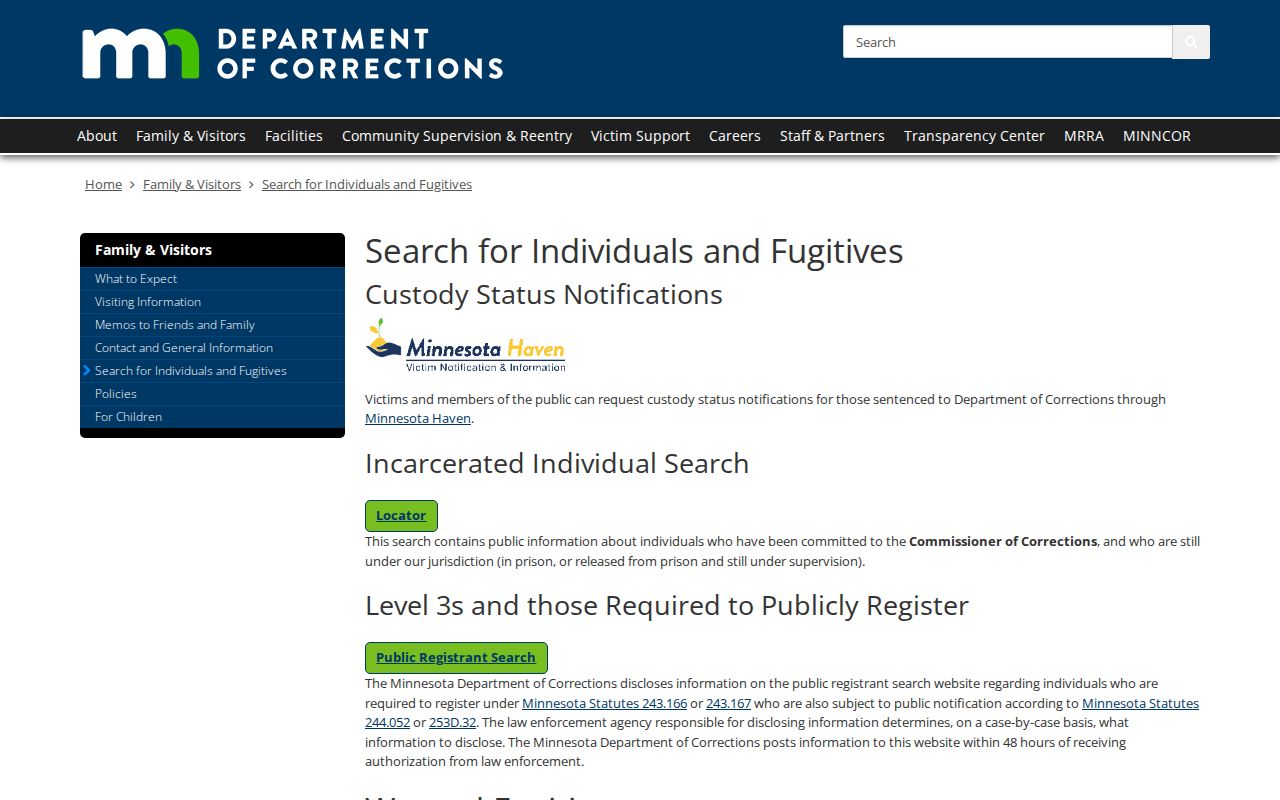
Those DOC modes are limited to adults under department jurisdiction and specific public-notification categories. They are not a Chaska or Carver County resident roll, and a name match should still be checked against date, role, and the correct official record.
Chaska Resident Lookup Vital Routes
Vital records can resolve a Chaska relationship or Chaska event date, but the index comes before the certificate request. Carver County Land Records & Vitals supplies Chaska local service, and the Minnesota Department of Health is the statewide custodian. Minnesota Historical Society tools provide historical Chaska leads. Carver can serve Chaska deaths in the county back to 1870 and statewide deaths from 1997. Minnesota records do not use one simple age rule for all events, so the correct form and eligibility standard must be checked for the record type.
All Minnesota death records are available as noncertified informational copies, while certified records have eligible-requester rules. Chaska birth certificates have their own restrictions under Minn. Stat. §§ 144.225 and 144.2252. MOMS is a searchable route for most Minnesota marriages, but a Chaska marriage certificate request belongs with an authorized vital-records office. A divorce decree belongs with the district court rather than the marriage system.
Carver’s Chaska death-certificate form makes the local request route concrete: the first certified copy is $13 and each additional copy ordered at the same time is $6. For a Chaska in-person request, complete the application but wait to sign with staff, show valid government photo identification, and arrive before 4:00 p.m. for guaranteed same-day issuance. A mail request requires the application, identification, payment, and a notarized signature. Verify the current form before ordering.
Record inventory. A vital index can supply a name, event date, place, or relationship lead. A certificate request adds its own application, identity, payment, and eligibility requirements.
Chaska Resident Lookup and MNVotes
For a Chaska self-check, MNVotes asks for first name, last name, full date of birth, and a complete Chaska address. It starts with ZIP-code or county mode, then uses city or township, house number, street, and unit details for the Chaska address when needed. Results confirm a voter’s own registration status and provide voting links. The system updates nightly, although election officials may take up to 14 days to process an application.
Minnesota’s public voter information list is controlled by Minn. Stat. § 201.091. A Chaska requester must be a registered Minnesota voter, identify themselves, and certify the limited permitted use. The list can include name, residence address, birth year, voting history, optional phone, and district information, but it excludes full date of birth and identification numbers. The data cannot be republished online as a searchable list. For personal registration, treat MNVotes as a self-check, not evidence to browse or publish.
Chaska Resident Lookup for Families
For an heir question, begin with a death index or certificate lead and an obituary, then search MCRO probate by the decedent’s name. Public petitions, orders, and estate filings can identify an executor or heirs where the file permits access. A LandShark transfer can then be compared with the parcel’s legal description. Cemetery indexes and the Barris or Glatzel files at the Chaska History Center can add relationship clues without treating a current address as the goal.
Minnesota offers a distinct official route for adult adoptees born in the state. An adult age 18 or older may request a noncertified original birth record from MDH under Minn. Stat. § 144.2252. The county cannot fulfill that original-record request. A birth parent’s contact-preference form accompanies the record but does not block an eligible adult adoptee’s access. These safeguards matter because a family connection requires documentation, not inference from a name.
Chaska Resident Lookup History Clues
When a name is historical, the Chaska History Center and Carver County Historical Society offer better leads than a current record alone. The Center holds yearbooks, local family genealogies, obituary work, newspaper originals, maps, house histories, cemetery indexes, and local-person files. The Chaska Herald index reaches back to 1862 and directs the reader to a publication date and page; the paper original is the place to read the item in context.
Yearbooks for Chaska High, Guardian Angels, Chaska Elementary and Middle, Clover Ridge, and Jonathan Elementary can anchor a class and year. In May 2026, the History Center became a FamilySearch Affiliate Library, giving onsite users access to some restricted FamilySearch images. A former classmate trail can combine a yearbook, a Herald reference, an obituary, cemetery material, and a dated property or probate record, while leaving protected current information alone.
Chaska Resident Lookup Privacy Limits
Public availability has boundaries. Safe at Home participants use a Saint Paul post-office-box address and unique lot number under Minn. Stat. ch. 5B; the real residential address is private. Court and vital files can be restricted, and driver information is not a general resident-search source. A property owner or tax mailing address can be outside Chaska and does not establish who occupies the property. A result that is absent, stale, or ambiguous should remain an unresolved lead.
The Minnesota Government Data Practices Act presumes government data are public unless another law classifies them otherwise. Under ch. 13, inspection of public data is free, and a narrow written request should identify the responsible department, record set, date range, name, address, PID, or case number. If immediate response is not possible, the agency generally responds within ten days excluding weekends and legal holidays. That process does not open confidential data.
Lawful use. Use a documented Chaska record for personal research, family history, estate questions, or confirming an official record. Do not use information to stalk, harass, monitor, or intimidate anyone.