
Chaska Previous Residents by Era
One Chaska address leaves different kinds of records in different eras. Each Chaska era requires its own source, so begin with the material closest to the time period, then use the next source to test a name or date. The Chaska property record identifies the parcel now, but the historical trail requires both the Chaska recorder and local collections. A deed can show transfer parties; it does not prove that either party was living there.
| Source | Years It Covers | Where Held | What It Shows |
|---|---|---|---|
| LandShark for Chaska parcels | 1988-present online | Carver County recorder portal for Chaska research | Party, document, and date index for the Chaska trail; images where available |
| Chaska recorded documents | Pre-1988 material available for counter research; first book date not published | Land Records & Vitals at the Chaska county counter | Chaska deeds, mortgages, liens, plats, annexations, and title instruments |
| Chaska phonebooks | 1909, 1911, selected years 1945-2024 | History Center and Historical Society inventory | Listed telephone subscriber, address, and occasional household or business clues |
| Chaska Herald and Carver County Sun | Herald index reaches 1862; Sun is late 1960s-early 1970s | Historical Society index and History Center paper files | Local events, notices, deaths, businesses, and address context |
| Chaska Sanborn and local maps | Selected maps from 1880 through 1935 | Chaska History Center, Historical Society, and selected Library of Congress material | Chaska building footprints, downtown block context, and historic uses |
| Chaska-area county census and naturalization | Census 1850-1930; naturalization 1862-1943 | Historical Society microfilm and Chaska onsite research access | Chaska household, relationship, age, birthplace, residence, and petition clues |
| Chaska building permits | Current SmartGov subset; historical online coverage not published | Chaska Building Inspections and the city data-request route | Chaska construction, alteration, owner or applicant, address/PID, and date details |
For a recent Chaska ownership question, start with the Chaska property record and move into LandShark. For an older Chaska household question, start with the known phonebook year, newspaper clue, map, or census, then use the Chaska deed trail to hold the parcel identity steady.
Freeze a Chaska Resident Address First
Before looking for previous residents, preserve the current situs address, parcel identification number, legal description, subdivision, lot, block, and any Abstract or Torrens indication. For a Chaska trail, the situs address is where the parcel is located. A Chaska tax-notice mailing address can be outside Chaska. The record owner is the assessed owner of a Chaska parcel, not a confirmation that the owner lives at the property.
Use the Carver County Property Information application to reach the Property Report Card, available plat, land-record link, and tax summary for a selected Chaska property. The county Plat Search can bridge an address or PID for a Chaska parcel to a lot, block, addition, and legal description. It accepts a PID without periods or hyphens. That Chaska parcel identity is more dependable than a street address when older records use abbreviated or changing address forms.
Chaska Previous Residents in LandShark
The Carver County LandShark portal is the online starting point for Chaska recorded-document research from 1988 forward. Search the current Chaska owner as a grantee, or use both parties when the current party role is uncertain. Capture the Chaska document number, recording date, grantor, grantee, deed type, legal description, and whether an image is available before moving backward. Images and the index are separate access layers.
| LandShark field | How it helps a backward search |
|---|---|
| Business or Last Name; First Name; Middle Initial | Locates a Chaska party by the form of the recorded name. |
| Search In | Choose Both Grantors & Grantees, Grantors Only, or Grantees Only to identify a Chaska party's transaction role. |
| Document Type; Instrument Group | Refines a Chaska results set where options are available in the live portal. |
| From Date; To Date | Limits Chaska results by recording period. Portal validation varies by search mode, so narrow ranges may be necessary. |
| Image controls | Preview, download, page selection, and payment or preauthorization prompts apply to Chaska document-image access. |
Do not use a Chaska surname alone as the chain. Compare the Chaska legal description, PID, lot, block, or plat with each candidate result. LandShark's grantor and grantee choices are valuable because the seller on one deed becomes the earlier buyer to search on the prior link.
Chaska Previous Residents in the Deed Chain
A Chaska chain of title is the sequence of ownership transfers for the same parcel. It is the backbone for a past-owner search, but it is only one part of a Chaska previous-resident trail. Carver County's recorder, located in Chaska, makes recorded documents available for research but does not do abstracting or lien searches for the public. For an Abstract parcel in Chaska, title research can require reviewing all instruments affecting title; a Torrens parcel follows its certificate of title and registered instruments.
- Open the current Chaska Property Report Card and record the owner, PID, situs, legal description, and available plat.
- In LandShark, find the current Chaska owner as grantee or search both roles, then locate the purchase deed and save its key details.
- Identify the seller, who is the grantor on that Chaska deed, and search that seller as a grantee for the earlier acquisition.
- Compare the Chaska legal description and parcel clues on every link. Stop when a transaction concerns a different parcel or a similarly named party.
- At the online cutoff, take the document details to the Chaska Land Records & Vitals counter or use a title researcher for a formal chain search.
- Grantor and grantee
- The grantor transfers an interest in the document. The grantee receives it. In a typical sale, the seller is grantor and the buyer is grantee.
- Chain of title
- The linked ownership transactions for one parcel, verified with legal-description and parcel details rather than names alone.
- Legal description
- The lot, block, addition, metes-and-bounds, or other property description used in recorded land documents. It is more stable than a street address for older research.
Keep each Chaska deed result with its recording date and source. A Chaska chain can show transfers into an estate, a foreclosure, a parcel split, or an annexation-related instrument, but these events must be read from the document and compared with the parcel record. They do not by themselves identify every past resident.
Chaska Previous Residents Before 1988
LandShark's online coverage begins in 1988. Earlier Chaska recorded documents are not an online dead end. The Chaska research route changes to the Carver County Land Records & Vitals counter at 600 East 4th Street, Chaska, where recorded documents are available for public research Monday through Friday, 8:00 a.m. to 4:30 p.m. Bring the Chaska parcel details and document clues gathered from the last online result.
The county has not published the exact older Chaska book or microfilm sequence. Ask staff for the Chaska historical-index direction needed for the specific parcel, and do not assume a document-image cutover year that the county has not stated. An abstractor, title researcher, or attorney is the appropriate next step for a formal title conclusion for a Chaska parcel; recorder staff do not provide legal advice or perform abstracting for the public.
For a Chaska gap involving construction or a remodel, use Chaska Building Inspections. The online SmartGov categories cover a stated current subset, while plan-review work has an email route and Chaska historical coverage is not published. Request a specific Chaska address through the city data-request process instead of assuming a broad historical permit search is online.
Chaska Past Residents in Phonebooks
Once the parcel trail identifies a Chaska time gap, the verified Chaska phonebook years can supply a listed subscriber or address clue. The Chaska local run begins with 1909 and 1911 and then appears in selected later groups through 2024. Work backward through the actual Chaska holding groups, rather than treating each year between them as a missing volume. A telephone listing can help place a person at a Chaska address, but it cannot establish every member of the household.
The local historical collections themselves are described in the Chaska City Directory. Its Chaska historical-collections material distinguishes verified phonebooks from unverified publisher claims and explains how to record an entry without adding information that does not appear in the volume.
Chaska Previous Residents in Census Gaps
Census schedules provide the household layer that deeds lack. Carver County Historical Society materials include state and federal census schedules from 1850 through 1930, with local state-census years including 1857, 1865, 1875, 1885, 1895, and 1905. They can show age, birthplace, occupation, relationships, and residence at enumeration. A census is a point-in-time record, so it should be paired with the nearest telephone listing or newspaper reference.
Use this address-to-household flow when tracking past residents:
- Match the address or legal-description area to the nearest phonebook or local directory year.
- Locate the nearest available state or federal census and record the household as it was enumerated, with its date.
- Check the Herald index for a marriage, death, business, school, or civic item that explains a change between records.
- Use naturalization microfilm, available for Carver County from 1862 to 1943, when an immigrant resident needs another dated local clue.
Do not turn a census neighborhood or a listed telephone subscriber into a complete roster for the property. Each source has a date and a scope, which is why the trail remains more accurate when its pieces stay separate.
Chaska Maps for Past Residents
For an older downtown address, maps can explain why a name appears near a brewery, brick yard, creamery, cannery, rail corridor, or civic square rather than under a modern street form. The Chaska History Center map collection provides old Chaska and downtown maps online and at the Center. The confirmed Sanborn sequence includes 1885, 1891, 1899, 1910, 1911, 1924, and 1935, with an 1880 county map also identified locally.
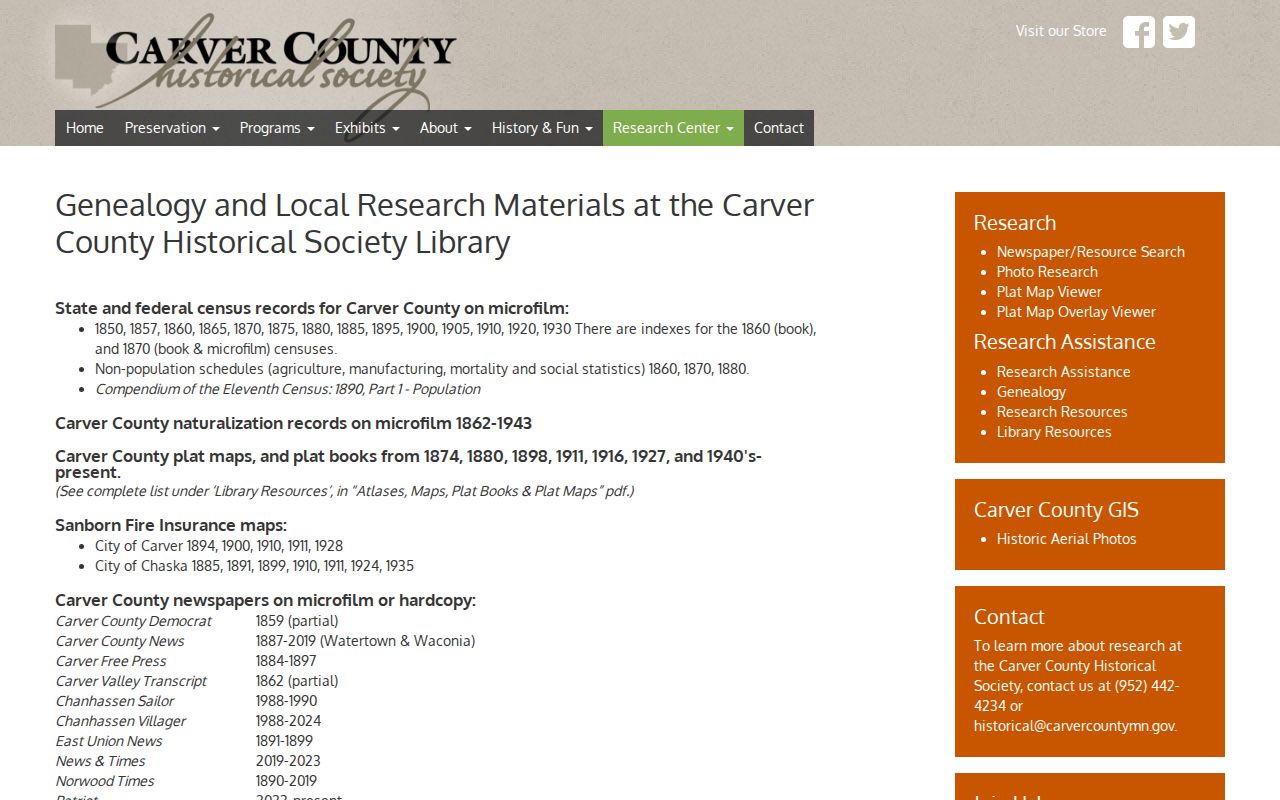
The Carver County Historical Society genealogy page describes the county's census, naturalization, plat, Sanborn, and newspaper holdings that support this backward trail.
Sanborn pages show buildings and uses, not a household roster. Pair them with phonebooks, deeds, newspapers, and the History Center's house histories to learn whether a structure was present and how a block changed over time.
Chaska Previous Resident Endpoints
When a person vanishes from the address trail, use obituary, cemetery, probate, and local name-file sources to test the reason. The History Center holds Glatzel obituary work, Barris clippings, cemetery indices, and local newspapers. A death or obituary can identify family ties; a probate file can place an executor or heir in the court record; a later deed can show an estate transfer. Those clues still need to be tied back to the same parcel and date range.
Safe at Home participants have protected real addresses under Minnesota law, and other court, vital, utility, and motor-vehicle data may be private. A records gap can be a legal boundary, not a research problem to work around.